Executive Summary
In a world where digital innovation disrupts every business function, vendor selection—the process through which organizations identify, evaluate, and onboard third-party vendors—is undergoing a fundamental transformation. No longer confined to siloed spreadsheets, email chains, and subjective judgement, modern vendor selection is being reshaped by automation, artificial intelligence (AI), workflow digitization, and data-driven insights.
By some estimates, digital procurement transformation can cut operational costs by up to 45% and reduce invoice processing cycles by as much as 70%—dramatic improvements that signal a permanent shift in how organizations approach RFPs and vendor management.
“In the race for competitive advantage, companies that digitize procurement aren’t just cutting costs—they’re unlocking strategic visibility into spend, risk, and supplier performance that transforms vendor selection from a tactical task into a strategic driver.”
This whitepaper explores the evolution from traditional to digital vendor selection, the key challenges this transition addresses, emerging technologies and best practices, and a practical checklist to assess digital readiness. It also highlights capabilities essential to modern vendor selection platforms, ushering procurement into a new era of strategic value, governance, and speed.
Let's see the glimpse below,
- Introduction: Why Vendor Selection Must Evolve
- The Traditional Vendor Selection Model: Strengths and Limitations
- Core Challenges with Legacy RFP & Vendor Selection Processes
- The Digital Shift: What’s Changing—and Why It Matters
- Intelligent RFP Processes: From Static to Dynamic
- Vendor Selection as a Lifecycle, Not an Event
- Automation and AI: Supercharging Vendor Selection
- Data-Driven Vendor Evaluation and Decision Making
- Governance, Risk, and Compliance in Digital Vendor Selection
- Industry Perspectives: Vendor Selection in Practice
- Checklist: Is Your Vendor Selection Process Digital-Ready?
- Yoroflow: Powering Digital-First Vendor Selection
- Best Practices for Digital Vendor Selection
- Future Trends in Vendor Selection
- Conclusion: Turning Procurement into Strategic Advantage
Introduction: Why Vendor Selection Must Evolve
Vendor selection historically sits within the procurement domain, focused largely on cost negotiation, contract terms, and meeting operational needs. However, three major forces are reshaping this role:
- Complex Vendor Ecosystems - Organizations now interact with diverse suppliers globally, spanning hardware, software, services, and cloud providers.
- Investor and Regulatory Focus on Risk - Compliance, data security, ESG criteria, and third-party risk demand deeper scrutiny of vendor relationships.
- Digital Expectations Across Business Functions - Procurement must match the speed and transparency that other departments (e.g., sales, finance, marketing) expect from digital tools.
As traditional processes creak under these demands, digital transformation becomes more than an efficiency play—it’s a strategic imperative.
“Vendor selection isn’t just about finding a supplier; it’s about establishing a partnership
that must deliver measurable value, minimize risk, and evolve with the business.”
The Traditional Vendor Selection Model: Strengths and Limitations
Traditional vendor selection typically involves:
- Preparing RFP or RFQ documents manually: Procurement teams draft requirements from scratch, often copying content from previous files. This manual effort increases the risk of inconsistencies, outdated terms, and missing evaluation criteria.
- Distributing via email or portals: RFPs are shared through long email threads or basic upload portals, making version control difficult and tracking vendor communication time-consuming.
- Collecting unstructured responses: Vendors submit PDFs, Word documents, or presentations, forcing teams to manually extract and compare information across formats.
- Compiling evaluations in spreadsheets: Reviewers score vendors separately, then consolidate feedback manually, increasing errors and subjectivity.
- Holding cross-functional review meetings: Stakeholders meet multiple times to align decisions, often extending timelines and delaying final vendor selection.
While familiar, this approach has systemic weaknesses:
- Lack of Standardization - Each RFP may differ, making apples-to-apples comparisons difficult.
- Data Silos - RFP responses, evaluations, contracts, and performance metrics live in separate places.
- Long Cycle Times - Manual collection and assessment slow decisions, delaying onboarding and execution.
- Limited Transparency - Stakeholders lack visibility into which vendors were considered, why decisions were made, and how performance is measured post-award.
This fragmented experience often results in misaligned expectations, compliance risks, and overlooked savings opportunities.
Core Challenges with Legacy RFP & Vendor Selection Processes
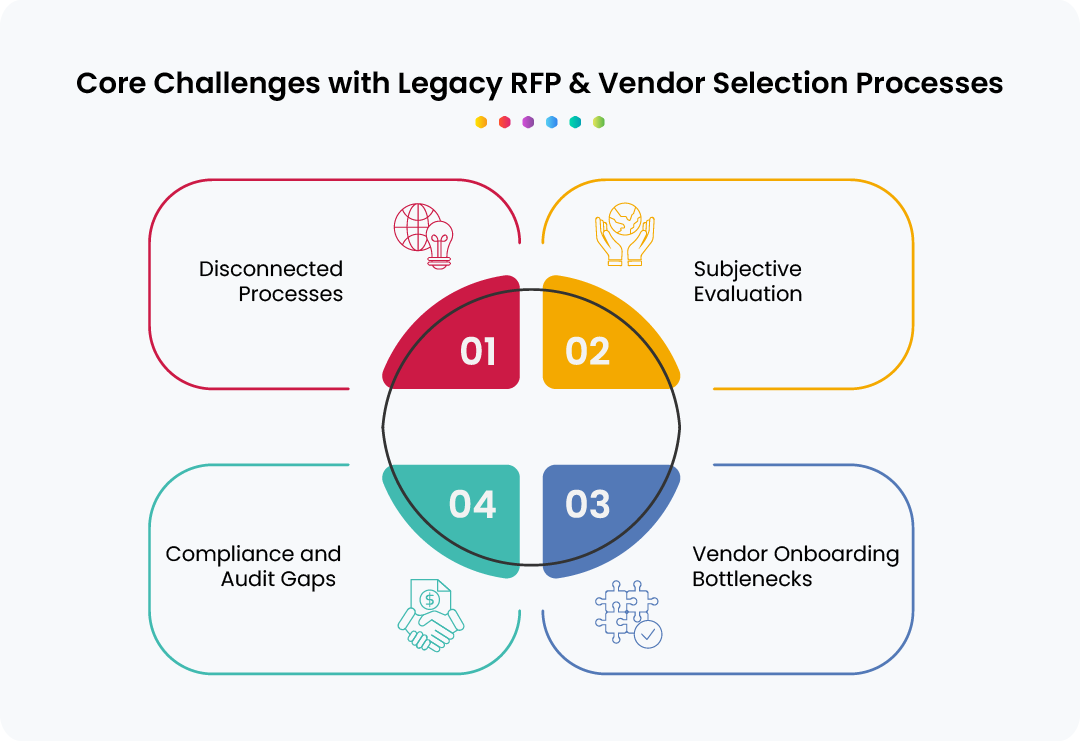
Procurement leaders around the world recognize several recurring pain points:
Disconnected Processes
In many organizations, RFP creation, vendor communication, evaluation, and contract execution happen across multiple disconnected tools. Procurement may draft documents in Word, collect responses via email, evaluate in spreadsheets, and send contracts through separate systems. This fragmentation creates data silos and forces teams to manually transfer information between platforms. The result is duplicated effort, version control issues, and increased risk of miscommunication. Instead of focusing on strategic evaluation, teams spend valuable time reconciling scattered data and chasing updates.
Subjective Evaluation
Without structured scoring frameworks or weighted criteria, vendor selection often relies on individual opinions. Different stakeholders prioritize different factors—cost, innovation, reliability, or speed—leading to inconsistent assessments. Decisions may hinge on internal influence rather than measurable performance data, making outcomes harder to justify and replicate.
Compliance and Audit Gaps
When decisions and approvals are tracked manually, generating a complete audit trail becomes difficult. Missing documentation, scattered emails, and informal reviews increase compliance risks and make audits time-consuming.
Vendor Onboarding Bottlenecks
After selection, onboarding frequently restarts as a manual process, requiring duplicate data entry and new approvals, delaying time-to-value.
The Digital Shift: What’s Changing—and Why It Matters
Digital transformation in procurement leverages software, data analytics, and automation to eliminate manual drudgery and enable strategic insight. According to recent industry research, 45% of procurement processes are fully automated in leading organizations, and 78% of procurement leaders believe digital transformation significantly improves efficiency and competitive advantage. (Digital Transformation In The Procurement Industry: ZipDo Education Reports 2026)
This shift toward digitization isn’t just about replacing paper with software—it’s about creating:
- Centralized data repositories that eliminate silos: Digitization brings all vendor information—RFP documents, responses, contracts, evaluations, and performance metrics—into a single, unified system. This removes dependency on scattered emails and spreadsheets, ensures data accuracy, and enables stakeholders to access consistent, up-to-date information across departments.
- Digital workflows that enforce process consistency: Automated workflows guide RFP creation, approvals, evaluations, and onboarding through predefined steps. This reduces manual errors, eliminates bottlenecks, and ensures every vendor goes through the same structured and compliant process.
- Structured evaluation frameworks that enable comparison at scale: Standardized scoring models and weighted criteria allow objective vendor comparisons, making decisions data-driven rather than opinion-based.
- Automated audit trails and compliance tracking: Every action is recorded digitally, improving transparency, governance, and audit readiness.
- Real-time insights that elevate strategic decision-making: Dashboards and analytics provide instant visibility into spend, risk, and vendor performance—transforming procurement from a transactional function into a strategic business advisor.
Digitization transforms procurement from a back-office function to a strategic advisor embedded in business planning.
Intelligent RFP Processes: From Static to Dynamic
Modern vendor selection begins with transforming the RFP itself from a static document into an intelligent digital artifact. Key capabilities include:
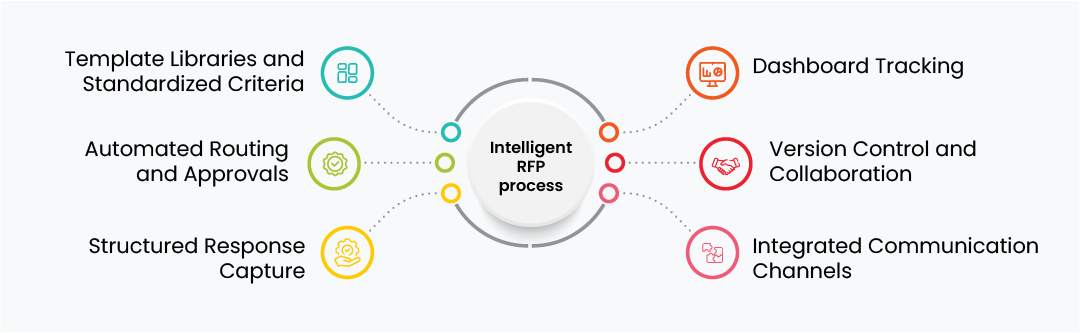
- Template Libraries and Standardized Criteria: Reusable RFP templates and predefined evaluation criteria bring consistency to every sourcing initiative. Teams no longer start from scratch, reducing preparation time while ensuring vendors are assessed against the same structured standards for fair and objective comparison.
- Automated Routing and Approvals: Configured workflows automatically move RFPs through finance, compliance, legal, and technical stakeholders. This reduces manual follow-ups, shortens review cycles, and minimizes bottlenecks that delay vendor selection.
- Structured Response Capture: Vendors respond through standardized digital forms instead of varied document formats. This ensures uniform data collection, simplifies analysis, and enables side-by-side comparisons at scale.
- Dashboard Tracking: Real-time dashboards provide visibility into submission status, review progress, and pending approvals, eliminating guesswork and reducing unnecessary status meetings.
- Version Control and Collaboration: Centralized document management ensures everyone works on the latest version, with tracked edits and comments improving transparency.
- Integrated Communication Channels: Built-in messaging keeps vendor clarifications and discussions documented within the RFP workflow.
With digital workflows, teams can complete selection cycles in weeks instead of months—speed that unlocks responsiveness in volatile markets.
“In the digital era, waiting weeks for RFP reviews isn’t an option—agility is the new currency of procurement.”
Vendor Selection as a Lifecycle, Not an Event
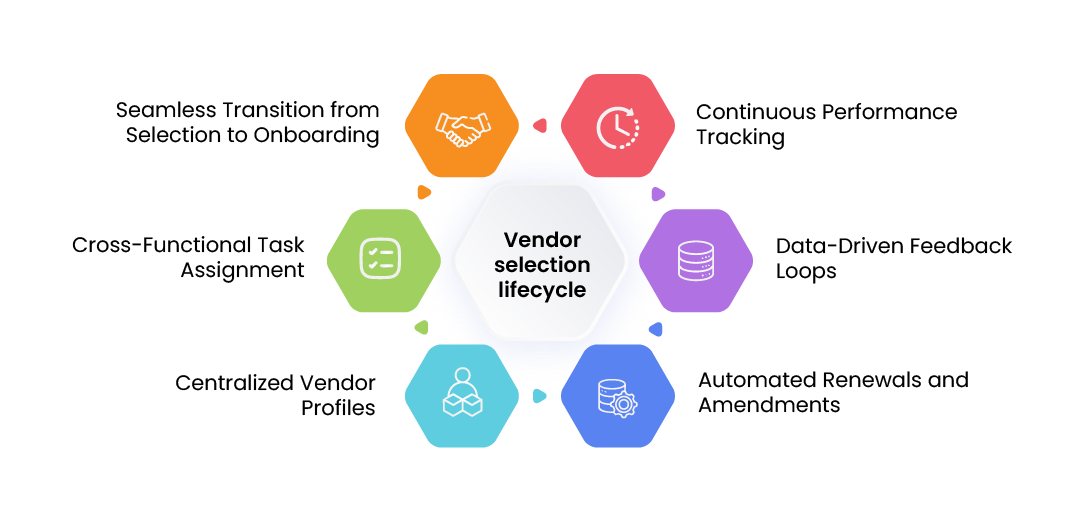
Once an RFP is completed and a vendor is selected, the journey continues:
- Seamless Transition from Selection to Onboarding: Once a vendor is awarded, digital systems automatically carry forward RFP data into onboarding workflows, eliminating duplicate data entry and reducing administrative delays.
- Cross-Functional Task Assignment: Onboarding tasks are intelligently routed to legal, finance, compliance, and operations teams, ensuring every requirement is completed efficiently and transparently.
- Centralized Vendor Profiles: All contracts, certifications, compliance documents, and communication records are stored in a unified vendor profile for easy access and governance.
- Continuous Performance Tracking: Ongoing monitoring of KPIs such as delivery timelines, quality benchmarks, and SLA adherence ensures vendors remain accountable beyond the initial contract award.
- Data-Driven Feedback Loops: Performance insights feed into future RFP evaluations, enabling smarter and more informed vendor selection decisions.
- Automated Renewals and Amendments: Alerts and workflow-driven contract reviews prevent missed renewals, rushed renegotiations, and compliance lapses, ensuring long-term vendor stability.
By viewing vendor selection as a lifecycle, organizations create continuous improvement loops—one vendor evaluation informs the next.
Automation and AI: Supercharging Vendor Selection
Digital transformation goes beyond digitizing forms—it embeds automation and AI to amplify human expertise.
- End-to-End Workflow Automation: Automated routing, conditional approvals, deadline reminders, and escalation triggers ensure RFPs and vendor evaluations move seamlessly across departments without manual follow-ups or delays.
- Rule-Based Compliance Enforcement: Built-in logic ensures vendors meet mandatory compliance requirements before progressing, reducing regulatory risk and preventing incomplete submissions from entering evaluation stages.
- AI-Assisted Evaluation and Scoring: AI models analyze structured and unstructured vendor responses against predefined criteria, generate preliminary scores, and highlight strengths or gaps—enabling faster, data-backed comparisons.
- Risk Identification and Pattern Detection: AI tools can surface hidden risks within large datasets, such as financial instability indicators, compliance inconsistencies, or performance red flags.
- Predictive Risk and Performance Insights: Advanced analytics assess historical vendor data, market conditions, and external signals to forecast potential performance issues or supply disruptions.
- Natural Language Processing (NLP) for Contracts: Text analytics extract key clauses, standardize contractual language, and flag deviations from standard terms for legal review.
- Continuous Learning Systems: AI engines improve over time by learning from past vendor outcomes, helping refine evaluation models and enhance future sourcing decisions.
Research from ZipDo suggests that AI and automation enable 40% of top procurement teams to adopt smarter sourcing strategies and inform decisions with predictive risk monitoring tools.
Data-Driven Vendor Evaluation and Decision Making
Vendor selection thrives on reliable, structured data—and digital platforms make that level of visibility and accuracy possible. Instead of relying on fragmented spreadsheets or subjective assessments, organizations can base decisions on measurable, comparable insights.
- Structured Evaluation Metrics: Digital dashboards enable standardized scoring across critical dimensions such as cost, risk exposure, compliance readiness, service quality, delivery timelines, and strategic alignment. Weighted scoring models ensure that vendors are evaluated objectively and consistently, reducing bias and strengthening defensibility.
- Historical Performance Insights: Data from previous vendor engagements—such as SLA adherence, issue resolution time, contract deviations, and overall satisfaction—feeds into future evaluations. These insights reveal trends and recurring risks that may not be visible in isolated assessments.
- Enhanced Spend Visibility: Digitally mature organizations achieve up to 92% spend visibility, compared to significantly lower visibility in manual environments. Greater transparency enables procurement teams to identify maverick spend, uncover renegotiation opportunities, consolidate vendors strategically, and optimize sourcing decisions.
With actionable data at their fingertips, procurement leaders shift from reactive purchasing to proactive, insight-driven vendor management.
Governance, Risk, and Compliance in Digital Vendor Selection
Modern vendor selection must balance performance outcomes with strong governance and proactive risk management. Digital systems embed compliance controls directly into the process, reducing exposure and strengthening accountability.
- Role-Based Access Controls: Digital platforms restrict access based on user roles and responsibilities. Only authorized stakeholders can view sensitive vendor data, modify evaluation criteria, or approve final decisions. This protects confidential information and ensures decision integrity across departments.
- Comprehensive Audit Trails: Every action—RFP creation, vendor submission, score modification, approval, or contract award—is automatically recorded. These time-stamped logs create a transparent and defensible audit trail, simplifying regulatory reviews and internal audits.
- AI-Driven Risk Scoring and Alerts: Intelligent systems assess vendor responses against compliance standards, financial stability indicators, sanctions databases, and regulatory requirements. Automated flags highlight potential red flags before contracts are finalized.
- Embedded Compliance Workflows: Mandatory documentation checks, certification validation, and approval gates ensure vendors meet policy and regulatory standards before progressing.
- Proactive Risk Mitigation: Continuous monitoring allows organizations to identify emerging risks early, protecting business continuity and reinforcing responsible vendor governance.
This governance layer protects organizations legally and strategically, turning vendor selection into a risk-managed, defensible process.
Industry Perspectives: Vendor Selection in Practice
Different functional groups approach vendor selection with distinct priorities, yet modern digital processes provide the flexibility and structure needed to support them all effectively.
- IT Procurement: IT teams prioritize data security, regulatory compliance, system compatibility, scalability, and SLA enforcement. They require detailed technical evaluations, risk assessments, and proof of integration readiness to ensure vendors align with enterprise architecture and cybersecurity standards.
- HR and Professional Services: HR departments and consulting engagements focus on cultural alignment, delivery quality, responsiveness, and adaptability. Vendor selection often includes qualitative assessments, references, and performance history to ensure long-term collaboration success.
- Marketing and Agency Partnerships: Marketing teams emphasize creativity, speed to market, innovation capability, and measurable ROI. Digital evaluation tools help compare campaign performance metrics, timelines, and strategic fit objectively.
- Finance and Outsourcing Providers: Finance leaders demand cost transparency, contractual clarity, regulatory compliance, and predictable performance. Risk mitigation and audit readiness are central to their selection criteria.
- Operations and Supply Chain: These teams prioritize reliability, delivery consistency, inventory management capabilities, and resilience against disruptions.
- Executive Leadership: Senior decision-makers evaluate strategic alignment, scalability, long-term value creation, and overall business impact, ensuring vendor relationships contribute to organizational growth objectives.
Across functions, digital workflows ensure consistent evaluation no matter the context.
“Procurement leaders don’t just negotiate contracts—they orchestrate relationships that shape the business’s ability to innovate and react to change.”
Checklist: Is Your Vendor Selection Process Digital-Ready?
Use this self-assessment to benchmark your current state and map your digital journey:
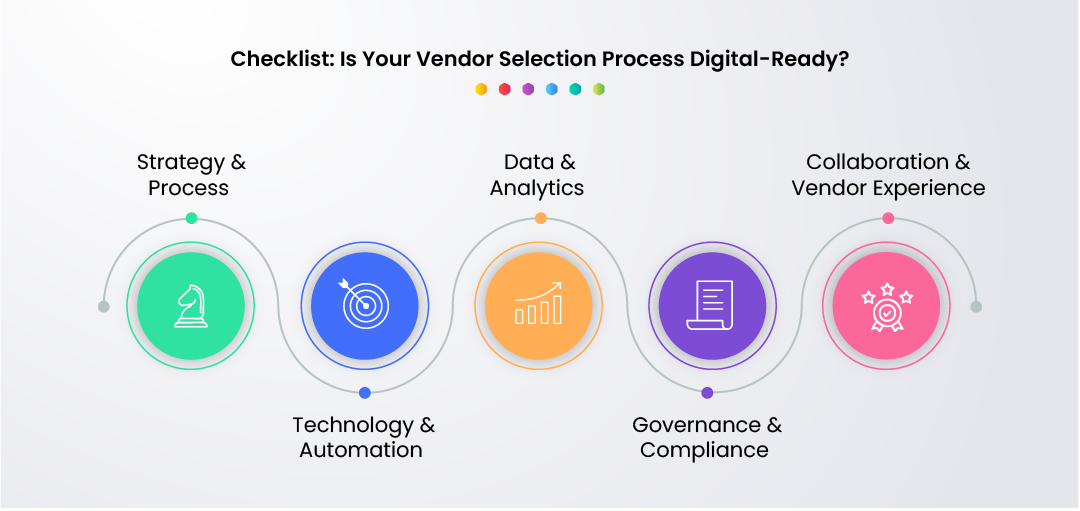
Strategy & Process
- Do you use standardized RFP workflows?
- Are selection criteria up-to-date and consistently applied?
Technology & Automation
- Are RFPs and evaluations conducted in digital tools with audit logs?
- Do workflows automatically route approvals and reminders?
Data & Analytics
- Can you visualize vendor performance, risks, and spend patterns?
- Do you use historical data to inform future selection decisions?
Governance & Compliance
- Are access controls in place?
- Are digital trails and documentation stored centrally?
Collaboration & Vendor Experience
- Do internal stakeholders collaborate in a shared platform?
- Do vendors interact with standardized forms and clear timelines?
Completing this checklist reveals gaps and illuminates the path toward a truly digital vendor selection engine.
Yoroflow: Powering Digital-First Vendor Selection
As organizations modernize procurement, platforms like Yoroflow enable the shift from fragmented, manual processes to fully digital, workflow-driven vendor management ecosystems.
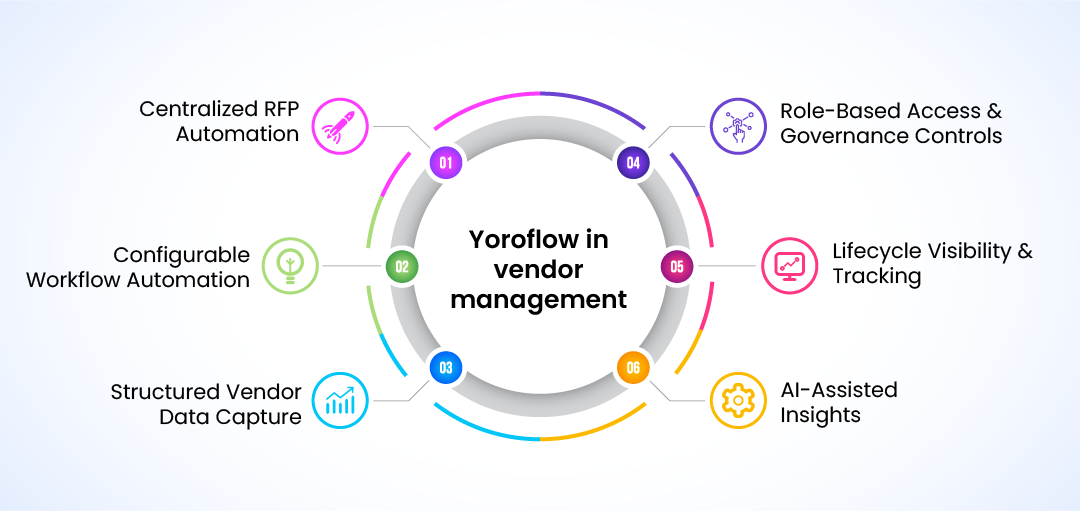
Yoroflow supports end-to-end RFP and vendor lifecycle management through:
- Centralized RFP Automation: Create standardized RFP templates with structured evaluation criteria, weighted scoring models, and automated approval routing—ensuring consistency across sourcing initiatives.
- Configurable Workflow Automation: Design rule-based workflows for RFP approvals, vendor evaluations, onboarding, compliance checks, and contract renewals—eliminating manual follow-ups and bottlenecks.
- Structured Vendor Data Capture: Use dynamic digital forms to collect complete, validated vendor information, certifications, compliance documents, and financial data in a centralized repository.
- Role-Based Access & Governance Controls: Ensure secure collaboration with permission-based access, approval hierarchies, and comprehensive audit trails for regulatory readiness.
- Lifecycle Visibility & Tracking: Monitor vendor performance, SLA adherence, contract milestones, renewals, and risk indicators through real-time dashboards.
- AI-Assisted Insights: Leverage intelligent analytics to identify evaluation patterns, highlight risk flags, and support faster, data-driven vendor decisions.
By combining workflow automation, governance controls, and analytics in a unified platform, Yoroflow transforms vendor selection from a disconnected administrative task into a structured, transparent, and strategic procurement engine.
Best Practices for Digital Vendor Selection
To achieve meaningful results from digital transformation, organizations must go beyond simply implementing new tools. Success depends on strategic alignment, process clarity, and cultural readiness.
- Standardize Before Automating: Clearly define workflows, approval hierarchies, evaluation criteria, and compliance requirements before digitizing them. Automation should enhance a well-designed process—not compensate for an undefined or inconsistent one. Standardization ensures scalability and fairness in vendor comparisons.
- Prioritize User Adoption: Even the most advanced platform fails without adoption. Engage stakeholders early, communicate benefits clearly, and design intuitive workflows that reduce effort rather than add complexity. Change management is just as important as technology implementation.
- Measure Outcomes, Not Outputs: Track metrics that reflect real impact—such as reduced RFP cycle times, improved compliance rates, stronger SLA adherence, and cost optimization. Avoid focusing solely on task completion or system usage statistics.
- Foster Cross-Functional Collaboration: Vendor selection impacts multiple departments. Align procurement, finance, legal, IT, and operations from the outset to ensure shared objectives and accountability.
- Invest in Talent and Training: Equip teams with the skills to interpret analytics, manage digital workflows, and leverage AI insights effectively. Technology delivers maximum value when paired with informed human judgment.
Future Trends in Vendor Selection
Looking ahead:
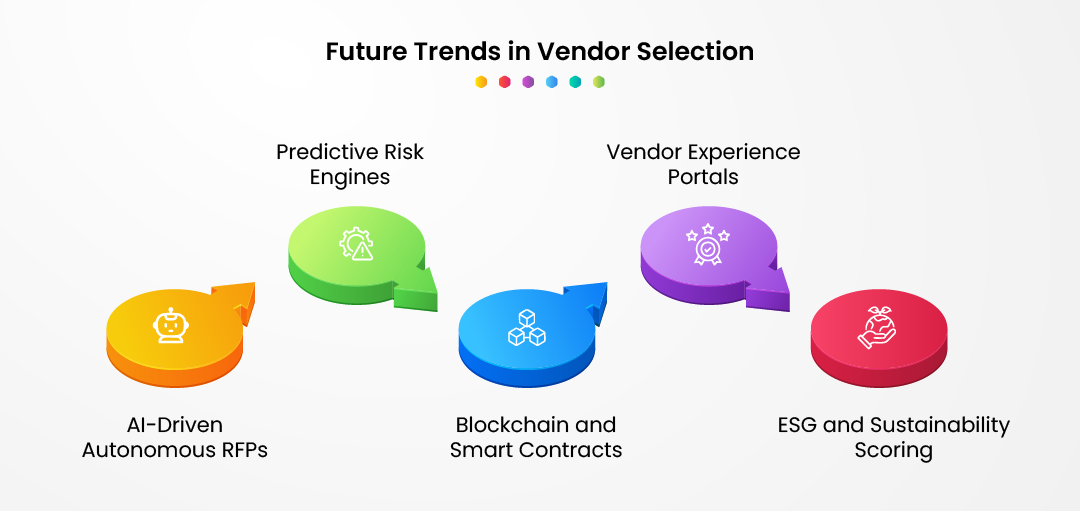
- AI-Driven Autonomous RFPs: Intelligent systems will automatically generate RFP drafts based on business requirements, historical data, and industry best practices—improving accuracy while significantly reducing preparation time.
- Predictive Risk Engines: Advanced analytics will forecast supplier stability, compliance exposure, and financial health months in advance, enabling organizations to mitigate risks proactively rather than reactively.
- Blockchain and Smart Contracts: Tamper-proof digital contracts may enhance transparency, ensure secure documentation, and automate compliance or payment triggers based on predefined conditions.
- Vendor Experience Portals: Modern platforms will shift from transactional engagement to collaborative ecosystems, allowing real-time communication, performance tracking, and innovation sharing with vendors.
- ESG and Sustainability Scoring: Environmental, social, and governance metrics will become critical evaluation dimensions, influencing vendor shortlisting and long-term partnership decisions.
Conclusion: Turning Procurement into Strategic Advantage
The evolution of vendor selection reflects a broader reality: organizations that digitize core business functions don’t just improve efficiency—they unlock strategic visibility, resilience, and competitive advantage.
Digital vendor selection is no longer about replacing spreadsheets with software. It is about creating structured workflows, embedding governance controls, leveraging AI-driven insights, and maintaining lifecycle visibility across every vendor relationship. When procurement operates with centralized data, automated approvals, standardized evaluations, and continuous performance tracking, it moves from a transactional function to a strategic decision engine.
Platforms such as Yoroflow demonstrate how workflow automation, role-based governance, structured RFP management, and real-time analytics can unify vendor selection into a single digital ecosystem. By connecting evaluation, onboarding, compliance, and performance monitoring, organizations reduce risk while accelerating value realization.
As business environments grow more complex and risk-sensitive, the question is no longer whether vendor selection should be digital—it is how quickly organizations can adopt structured, intelligent platforms to transform procurement into a measurable strategic advantage.